
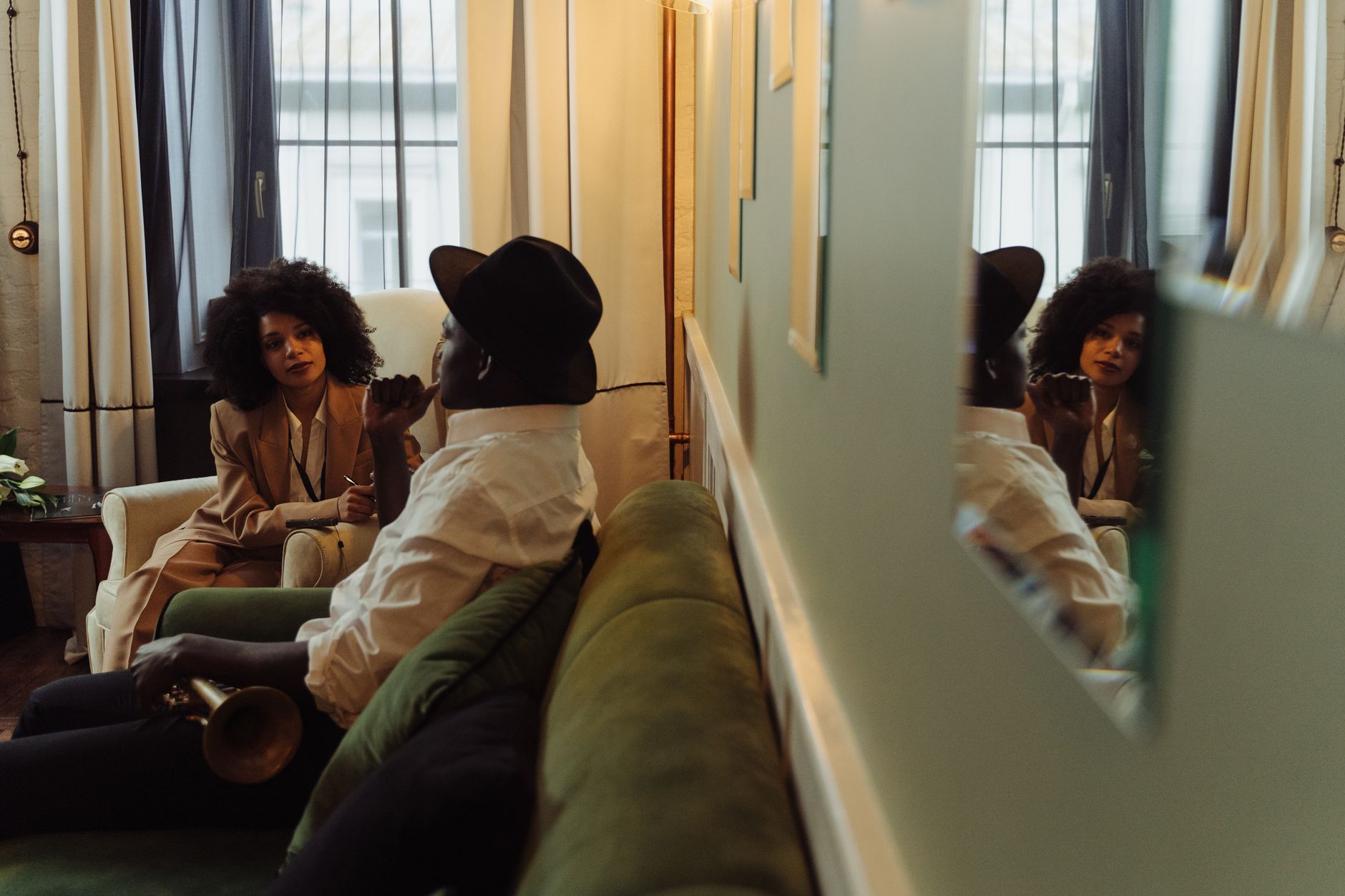
Fifteen minutes. Twenty if the publicist is in a good mood.
That's a press junket: one hotel floor, twenty outlets, one day, a subject cycling through the same four stories with slight variations. A global marketing spend, amortized. None of this is a failure of ambition on anyone's part. A junket is a distribution mechanism, and it does that job well.
A master-level magazine profile is a different species of work entirely. It runs 3,000 to 6,000 words. It isn't built to move tickets. It's built to answer a question the subject probably hasn't been asked in a way they can rehearse. Start with the arithmetic, because the arithmetic explains the craft.
The 15-Minute Problem
Dedicated direct access negotiated for high-tier national magazine profiles typically lands between two and six hours. Not twenty minutes. Hours — often split across multiple days, sometimes across multiple locations, occasionally across months of intermittent contact.
That may not sound like much. Six hours with a movie star is still six hours, and a disciplined person can stay in character for six if they want to. Which is exactly why the access window is only one of four moving parts.
Inside the Four-Phase Structure
The GQ framework, as documented in editorial research on the magazine's process, breaks into four distinct phases. They don't run in a straight line — experienced profilers move between them constantly. But each one solves a problem the others can't.
Phase 1: Archival Mapping
Before a single question gets asked, the profiler audits six to twelve months of previous press clips. Not to gather facts — anyone can read a Wikipedia page. The point is to map the PR script.
Ten months of junket videos, late-night appearances, podcast spots and red-carpet hits will surface the same three or four stories told with slight variations. The film-set anecdote that always lands. The joke about the director that always gets a laugh. The childhood detail that gets deployed whenever the conversation drifts somewhere uncomfortable.
Once you've cataloged those, they become unusable. You can't build a profile out of material the audience has already seen. More practically, you can't let a subject spend an hour of a four-hour window running their greatest hits.
There's a second function here that's easy to miss. The archive shows you what the subject's handlers want the story to be. Six months of coverage organized around a single narrative — the comeback, the reinvention, the difficult-genius framing — tells you what resistance you're likely to meet when your reporting points somewhere else.
Phase 2: Negotiating Real Access
This is the phase that gets written about least and eats the most calendar time.
Public relations handlers enforce restrictive topic bans and compressed timeframes that prevent deep narrative inquiry. That's not cynicism — it's an operational reality of the beat. Schedules collapse. A press tour gets extended. An unrelated story breaks and suddenly the subject's team wants the piece postponed or softened.
So two to six hours is a benchmark, not a guarantee.
What a profiler is negotiating for isn't just duration. It's the absence of an agenda. A two-hour sit-down with a publicist in the room is a junket with better furniture. A four-hour afternoon with no fixed endpoint is something else entirely, because the subject eventually runs out of prepared material and has to find out what they actually think.
Phase 3: Experiential Fieldwork
This is where the framework stops resembling an interview at all.
Phase 3 shifts sit-down Q&A into experiential fieldwork and shared activities. The stated purpose is to observe environmental and somatic cues — how someone behaves when they're not being watched by a handler in a hotel suite. A kitchen, a driving range, a hike, a workshop. Somewhere the subject has to *do* something.
The logic: verbal answers are the most heavily managed output a media-trained person produces. Physical behavior is much harder to script. Someone who claims to be relaxed while gripping a coffee cup until their knuckles go pale is telling you two different stories, and a room-based interview only gives you access to one of them.
Worth flagging the epistemic line here, because it's where a lot of profile writing quietly overreaches. Observing that a subject checked their phone eleven times during a ninety-minute session is reportable. Concluding from that what they *feel* about their career is interpretation, and it needs to be labeled as such in the finished copy.
The framework's strength is behavioral evidence. Its vulnerability is treating that evidence as a window into a mind.
Phase 4: Narrative Construction
The last phase is the one readers never see, and it's where the 3,000-to-6,000-word benchmark earns its keep.
Archive material becomes structure: the rehearsed anecdote gets printed *as* a rehearsed anecdote, with the surrounding context made visible. Fieldwork becomes scene. Access constraints become part of the story rather than an inconvenience to be hidden.
That's where one of the more interesting recent turns in the form shows up — meta-reporting, telling the story of the story itself, folding the PR friction and the awkward silences and the sudden schedule changes directly into the narrative as evidence about the subject's environment and the people managing it.
It's a clever move, and it's also a defensive one. If you can't get the clean interview, you report the conditions that prevented it.
- Paraphrasing the framework research rather than quoting any editor directly: deep background immersion, archival cross-referencing, and probing inquiry are treated as the load-bearing wall of the profile, with the sit-down interview functioning as confirmation rather than discovery.
What the Archery Range Actually Buys You
The clearest illustration in the available material is also the simplest.
A profiler audits ten months of junket videos and identifies a rehearsed anecdote about a film set — the same story, told the same way, across a dozen outlets. Instead of asking about it, they move the interview to a local archery range. What gets captured there, per the case description, is how the subject handles physical frustration outside a controlled room.
One detail gets overlooked in retellings of examples like this: the archery range isn't a trick and it isn't a gotcha. It's a controlled variable swap. The subject can still choose what to say. What they can't easily do is manage an entire environment while managing their own narrative at the same time. The anecdote loses its grip because the room that produced it is gone.
Whether any of that reveals something a reader genuinely needs to know about a person is a separate question, and one the framework doesn't answer on its own. That's where the method starts to strain — and where its critics do their best work.
Tabula Rasa and the Prepared Mind
The Jeanne Marie Laskas model approaches profile subjects as a blank slate — tabula rasa — without pre-established biases during initial encounters. That's a fundamentally different posture from archival mapping, which asks the profiler to walk in with ten months of clips already parsed and a working theory about what the subject will dodge.
Both approaches are documented. Both are used by serious reporters. And they pull in opposite directions.
Archival preparation protects you from wasting limited access on ground you could have covered from your desk. Blank-slate openness protects you from the opposite failure: walking in so certain of the story that you can't see the person producing it.
Nobody has published a reliable method for determining the right balance between the two, and the balance likely varies by subject, by desk, and by how much access you actually secured. That's a gap in the evidence, not a debate that's been settled and forgotten.
The Counter-View: Maybe the Immersion Model Is Overrated
It's worth taking the dissent seriously, because it isn't fringe.
The strongest version goes like this: the immersion model is expensive, hard to replicate, and structurally unavailable to most working journalists. Which means it gets written about as an ideal when it's closer to an exception. A freelance features writer with a 90-minute window and a Thursday deadline can't negotiate five hours across three locations. If the framework's value depends on access most of the industry will never have, its usefulness as a transferable method is smaller than its reputation suggests.
There's a sharper version too. Fieldwork scenes can be as manufactured as any junket set piece — the difference is that the writer controls the staging, not the publicist. A rooftop conversation at golden hour is a constructed environment whether or not a studio paid for it. And when a profiler reads frustration at an archery range as evidence of interiority, they may simply be reading their own hypothesis back out of ambiguous behavior.
Then there's the reader-side objection, rarely voiced in craft conversations. Plenty of readers don't want the machinery. They want the anecdote, the voice, the sense of a person. The meta-reporting turn that makes a profile feel rigorous to editors can read as self-indulgent to the person who picked it up on a flight.
That critique doesn't dismantle the framework. It does suggest the framework is best understood as a method for a specific kind of commission — the long lead-time, high-access narrative feature — rather than a universal standard for interviewing.
Key Uncertainties and Open Questions
Which leaves a short ledger of things the evidence simply doesn't settle.
There's no published, universal answer to where pre-interview immersion should stop and blank-slate neutrality should begin. Different editorial desks land in different places, and nothing in the research here quantifies an optimal split.
Access negotiation is unpredictable by nature. Celebrity PR teams can enforce sudden schedule compressions or topic boundaries mid-process, which makes any four-phase workflow descriptive of intent rather than a guarantee of execution. A framework that assumes two to six hours can be planned for on Tuesday and reduced to forty minutes by Thursday.
The most significant gap is outcome data. Nothing in the supplied material links any specific phase to measurable reader engagement, subject cooperation, or editorial impact. The 3,000-to-6,000-word range is a benchmark for the format, not evidence that longer profiles outperform shorter ones.
And the interpretation of somatic cues is inference, not measurement. How reliably different reporters reach the same reading from the same behavior is untested here, and I'd treat any claim of consistency with skepticism. That's the right posture — skepticism, not paralysis.
A Practical Field Guide for Working Profilers
- Budget the archive before you budget the interview. Six to twelve months of clips is the documented range. Ten months was enough in the case example to isolate a single rehearsed anecdote. Work backwards from your access date, not forwards.
- Catalog the script, then retire it. Log the recurring stories across outlets. Their value after that point is as evidence of management, not as material.
- Treat access as a range, not a number. Two to six hours is the benchmark. Build your question set so that the five most important threads can survive a 40-minute compression without collapsing.
- Move the room. If you can only change one variable, change the environment. A shared activity produces behavior a hotel suite can't.
- Label your inferences in the copy. Report what you saw. Flag what you think it means. Readers can handle the distinction, and it protects you from the most common failure mode in the form.
- Don't hide the friction. Meta-reporting turns a blocked question into evidence rather than a hole in the piece.
Where the Form Is Heading
The pressure is running in one direction. Press cycles are getting shorter, PR teams are getting more sophisticated about narrative management, and the number of outlets commissioning 5,000-word profiles with multi-day access keeps shrinking.
Against that, the framework's most transferable insight isn't the access window. It's the sequencing. Audit first, negotiate second, move the location third, build the story last. That order works with six hours or with ninety minutes; the scenes just get smaller.
The New Journalism comparison gets made a lot in craft circles, and it usually misses the point. What's happening here isn't a stylistic revolution. It's a defensive adaptation — reporters building structure into the process because the access itself is no longer reliable enough to carry a piece on its own.
Trade criticism of profile practice, including the kind published by outlets like the Columbia Journalism Review, has circled this problem for years without resolving it. The same questions that dogged Esquire's profile tradition in the 1960s still apply: how much of a person can reporting actually reach, and how much of what gets printed is the writer's own construction wearing the subject's clothes?
That's the question the four-phase method is built to ask, and it's the question it still can't answer. Which is fine. A method isn't a truth machine — it's a way of narrowing the distance between what you can prove and what you're tempted to claim.
So run the audit, book the extra hour, get out of the room. Then label what you saw, own what you inferred, and let the reader decide how much of the person actually made it onto the page.
FAQ
How does the GQ profile framework differ from standard press junkets?
Standard press junkets rely on compressed 15-to-20-minute Q&As designed to promote specific releases. The GQ framework uses a four-phase methodology combining archival audits, multi-day experiential fieldwork, third-party reporting, and meta-reporting to bypass rehearsed PR scripts.
How much access time does a national magazine profile need?
Dedicated direct access negotiated for high-tier national magazine profiles typically ranges from two to six hours. That's the benchmark, not a guarantee — PR teams can compress schedules with little notice.
Why audit six to twelve months of press clips before interviewing?
The audit maps a subject's PR script, identifying the rehearsed anecdotes, canned jokes, and managed narratives. That way the profiler doesn't spend limited access time re-recording material the audience has already seen.
How long should a finished profile be?
Major magazine print cover profiles and narrative features typically target 3,000 to 6,000 words. The length reflects the reporting depth the format assumes, not a hard editorial rule.
What's the biggest limitation of the immersion model?
Access. The multi-location, multi-day version of the method isn't available to most working journalists, and there's no published outcome data showing that its outputs perform measurably better than shorter, more conventional profiles.
Key Takeaways
- The GQ framework's core value is sequencing, not access: six to twelve months of archival mapping, two to six hours of negotiated access, experiential fieldwork, then narrative construction.
- Junkets and profiles aren't better or worse versions of the same thing. A 15-to-20-minute promotional Q&A and a 3,000-to-6,000-word narrative investigation have different jobs.
- Experiential fieldwork produces behavioral evidence. It does not produce reliable insight into someone's inner life unless the writer labels that leap as interpretation.
- Meta-reporting — folding PR constraints and awkward conditions into the piece — turns blocked access into material instead of a hole.
- The method is best understood as a specialty format for high-access commissions. Its transferability to ordinary reporting conditions remains genuinely unproven.
Reader Discussion
0No comments yet. Be the first to share your thoughts, strategic perspective, or feedback on this guide!
Post a Comment
Join the discussion. All constructive feedback and editorial insights are welcome.