


To catch tonight’s northern lights across the northern United States, your ideal viewing window falls between 10:00 PM and 2:00 AM local time, with activity typically peaking around local midnight. To actually see the display, you must position yourself in a dark-sky location away from urban light pollution, face north with a clear horizon, and verify that real-time space weather data supports an active geomagnetic storm.
Rather than relying on generic three-day forecasts, successful aurora hunting depends on tracking live solar wind metrics broadcast from deep space. If your location sits along or north of the NOAA SWPC viewline, a geomagnetic activity level of Kp 4 to Kp 5 is usually enough to reveal glowing green pillars along the northern boundary, while a storm hitting Kp 6 or higher can pull vibrant curtains directly overhead across lower-latitude states.
The Solar Engine: Why the Northern Lights Are Active Right Now
We are currently navigating the energetic crest of Solar Cycle 25, a period marked by elevated solar activity. However, you do not need a massive solar flare to experience a breathtaking display. Scientists frequently observe the aurora lag effect, a phenomenon where decaying sunspot regions and long-lived coronal holes continue to stream high-speed plasma toward Earth even as solar surface flare counts temporarily quiet down.
- Key Summary & Flow: Sun's Coronal Hole / Sunspot
- ▼ (High Speed Solar Wind)
- DSCOVR Satellite at L1 Point
- (~1,000,000 Miles from Earth)
- ▼ (15–60 Minute Advance Warning)
- Earth's Magnetosphere (Bz Tilts South)
- Auroral Oval Expands Over Northern US
These solar wind streams carry charged particles across the solar system at millions of miles per hour. As this solar wind approaches Earth, it encounters our planet's magnetic bubble—the magnetosphere.
For these charged particles to leak into our upper atmosphere and ignite atmospheric oxygen and nitrogen, a specific magnetic condition must occur. The solar wind carries its own interplanetary magnetic field. When the southward-pointing Bz component of this field dips into negative numbers, it effectively cancels out Earth's northward magnetic orientation.
Think of a negative Bz as opening a magnetic trapdoor. When that door swings open, energetic particles plunge into Earth's ionosphere along magnetic field lines, triggering the shimmering ribbons of light we see from the ground.
Core conceptual framework and workflow breakdown for How to See Tonight’s Northern Lights: Peak Times, Viewing Maps, and Best Spots Across 11 States
Reading the Gauges: How Real-Time Data Predicts the Display
To catch an auroral outbreak, you must understand three core scientific metrics measured by monitoring satellites:
- The Kp Index Scale: A standardized 0 to 9 numerical range used to quantify global geomagnetic storm strength. A baseline Kp 0–2 represents quiet conditions, Kp 4 indicates an active state, and Kp 5 or above marks an official geomagnetic storm.
- The Sun-Earth L1 Point: A gravitational balance point located approximately 1,000,000 miles from Earth. Satellites like NASA’s DSCOVR sit at this position, sampling incoming solar wind right before it hits our planet.
- The OVATION Forecast Lead Time: Because the DSCOVR satellite sits at the L1 point, its real-time solar wind measurements give skywatchers a crucial 15 to 60 minute lead time window. NOAA’s OVATION model uses this live data stream to map the location and intensity of the auroral oval in real time.
- The NOAA SWPC Viewline: A dynamic boundary drawn on space weather maps that marks the southernmost geographic line where an observer can reasonably expect to see an aurora glowing on the northern horizon, assuming clear skies and dark conditions.
State-by-State Viewing Guide: Top Locations Across 11 Northern States
When geomagnetic activity surges, location is everything. Below is a curated regional guide for prime viewing locations across 11 northern US states, categorized by their structural horizon profile and minimum required activity threshold.
| State | Minimum Kp Required | Prime Dark-Sky Location | Regional Viewing Advantage |
|---|---|---|---|
| Washington | Kp 4 to 5 | North Cascades Highway (Diablo Lake Overlook) | High elevation elevates you above low mountain valleys. |
| Idaho | Kp 4 to 5 | Priest Lake State Park (Northern Shore) | Pristine dark skies with clear line-of-sight over water. |
| Montana | Kp 4 | Glacier National Park (Lake McDonald) | Unmatched northern horizon views over low mountain basins. |
| North Dakota | Kp 3 to 4 | Theodore Roosevelt National Park | Minimal light pollution with expansive 360-degree plains. |
| Minnesota | Kp 3 to 4 | Boundary Waters Canoe Area Wilderness | Deep dark-sky sanctuary free from city light domes. |
| Wisconsin | Kp 4 | Apostle Islands National Lakeshore | Wide-open sightlines looking directly north across Lake Superior. |
| Michigan | Kp 3 to 4 | Headlands International Dark Sky Park | Specialized dark-sky preserve situated on Lake Michigan. |
| New York | Kp 5 | Adirondack Park (Heart Lake / Tupper Lake) | High-altitude shield blocking urban light spill from the south. |
| Vermont | Kp 5 | Lake Champlain (North Hero State Park) | Unbroken northern water horizon toward the Canadian border. |
| New Hampshire | Kp 5 | White Mountain National Forest (Dixville Notch) | Mountain pass elevations offering clean horizon sightlines. |
| Maine | Kp 4 | Aroostook County (Milford / Katahdin Region) | Longitude and deep forest wilderness yield exceptionally dark skies. |

Real-world setup and actionable execution in practice
The Field Playbook: Step-by-Step Chasing Strategy
Chasing the northern lights successfully requires structured execution. Follow this simple operational timeline on the night of your hunt.
Field Hunting Timeline
| 3 HOURS BEFORE: Check cloud cover maps & scout Bortle 1-3 sites |
|---|
| 1 HOUR BEFORE : Monitor DSCOVR satellite at L1 (Look for -Bz) |
| 30 MINS BEFORE: Verify NOAA OVATION model show high aurora flux |
| ON SITE : Dark adapt eyes for 20 mins; test camera sensor |
1. Monitor the Deep-Space Satellites (1 Hour Before Departing)
Open the NOAA Space Weather Prediction Center (SWPC) dashboard on your phone. Look at the real-time magnetic field plot coming from the DSCOVR satellite parked at the L1 point.
Focus on the Bz reading (measured in nanoTeslas, or nT). You want to see the Bz line drop firmly into the negative numbers (ideally -5 nT to -15 nT or lower) and stay there for at least 30 minutes. If the solar wind speed simultaneously climbs above 400 to 500 kilometers per second, an auroral display is likely unfolding.
2. Check the OVATION Model (30 Minutes Before Departing)
Consult the live NOAA OVATION model map. Look at the dynamic intensity overlay and the NOAA SWPC viewline.
If your planned viewing location sits on or north of the red viewline boundary, the aurora will be visible low on your northern horizon. If the red intensity mass moves directly over your state on the map, prepare for display pillars high in the sky or overhead.
3. Escape Light Pollution and Scout the Horizon
Position yourself in a location rated Bortle Class 1, 2, or 3 on a light pollution map. Make sure your immediate northern view is completely unobstructed by trees, structures, or distant urban light domes. Lakeshores, high elevation overlooks, and open farmland fields offer the best sightlines.
4. Optimize Camera Gear and Eye Adaptation
Give your eyes at least 20 minutes to adapt to full darkness without looking at bright screens or headlights. Because human night vision relies on rod cells that process light in monochrome, faint auroral displays often appear to the naked eye as milky white or gray glowing pillars.
Modern digital cameras and smartphone sensors pick up light far more efficiently than the human eye.
To capture vivid color, set your camera or phone to manual or night mode:
- Mount your device on a steady tripod.
- Set your focus manually to infinity.
- Open your lens aperture as wide as possible (e.g., f/1.8 to f/2.8).
- Set your ISO between 1600 and 3200.
- Expose for 4 to 8 seconds (exposing too long turns sharp, shimmering pillars into a blurry green smudge).
Honest Pitfalls to Avoid: What Most Chasers Get Wrong
Even experienced outdoors enthusiasts miss displays due to a few common errors.
The "Static App Trap"
Many mobile applications push dramatic notifications claiming an aurora is imminent based entirely on long-range, static three-day forecasts. These long-range models frequently miscalculate the exact arrival time of solar wind streams. Relying on fixed time predictions rather than live satellite data from the L1 point often leads to sitting in a dark parking lot hours too early or missing the display entirely.
The "Positive Bz" Illusion
A common frustration occurs when the overall Kp index reads high (such as Kp 6), yet skywatchers see nothing but blank stars. This happens when the Bz component flips positive (northward).
Even if the incoming solar wind speed is extremely fast, a positive Bz means Earth's magnetic shield remains effectively closed, deflecting the solar wind around the planet rather than letting it enter the upper atmosphere. Always check the Bz direction before committing to a long late-night drive.
Mismatched Visual Expectations
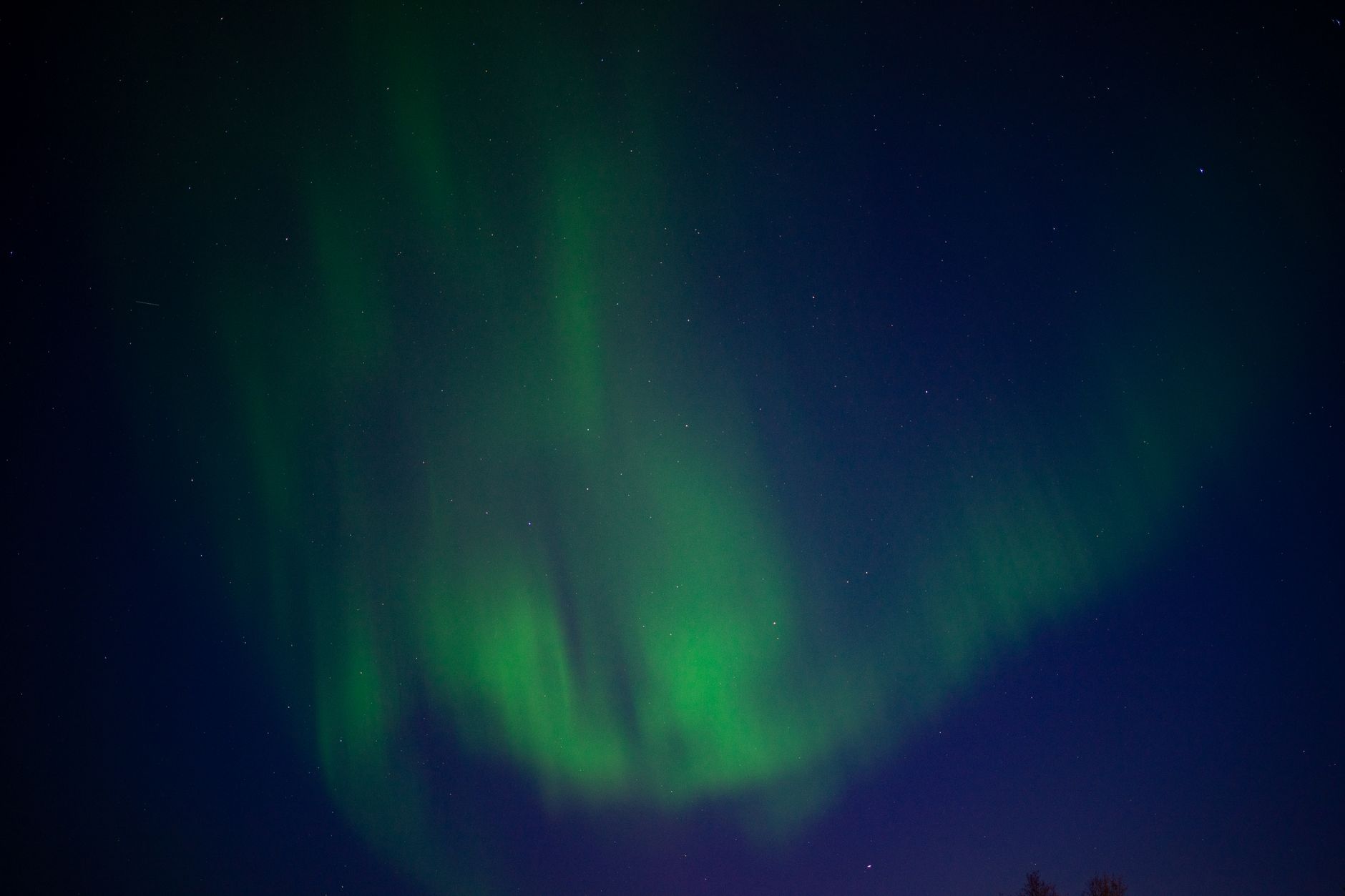
First-time chasers often expect to see vivid, electric-green curtains moving across the night sky exactly as they appear in long-exposure photo essays. In reality, moderate auroral activity often registers to the naked eye as tall, gray, cloud-like columns shifting along the horizon.
Always point a camera taking a 3-second test exposure toward suspect light pillars. If the digital image comes back emerald green or magenta, you are looking at the aurora.
Atmospheric Moisture and Low Clouds
A crystal-clear weather forecast can be deceiving. Ground-level fog, high-altitude thin cirrus clouds, or humidity coming off a cold body of water can diffuse auroral light. Always cross-reference satellite cloud coverage maps with localized dew-point spreads before settling on a viewing location.
Frequently Asked Questions
Can I see the northern lights if the moon is bright tonight?
Yes, but a bright moon will wash out faint auroral pillars. During a high-intensity geomagnetic storm (Kp 6 or greater), the aurora is bright enough to cut through moonlight easily. If the storm is moderate (Kp 3 to 4), position yourself so the moon is behind you or blocked by a terrain feature, leaving your northern sky view as dark as possible.
Why does my phone camera show bright colors when my eyes only see faint white rays?
Human visual physiology relies on rod cells in low-light environments, which are sensitive to brightness but incapable of processing color. Smartphone and camera sensors accumulate light over multi-second exposures, revealing the vivid green emitted by oxygen atoms at altitudes of 60 to 150 miles, as well as the deep crimson and purple light produced by high-altitude nitrogen collisions.
What is the difference between a CME and a coronal hole stream?
A Coronal Mass Ejection (CME) is a massive, discrete explosion of magnetic field and solar plasma hurled into space by active sunspot groups. CMEs hit Earth abruptly and often cause intense, short-lived geomagnetic storms. A coronal hole high-speed stream, by contrast, is a continuous river of fast solar wind flowing out of open magnetic field regions on the Sun. These streams generate broader, more gradual, and longer-lasting auroral viewing windows.
How far south can the aurora travel during peak geomagnetic storms?
During extreme space weather events rated Kp 8 or Kp 9 (G4 to G5 geomagnetic storms), the auroral oval expands dramatically southward. Under these rare conditions, the NOAA SWPC viewline shifts down into states like northern California, Oklahoma, North Carolina, and deep into the American Midwest. During typical active conditions (Kp 4 to Kp 6), viewing remains concentrated across the 11 northern border states covered in this guide.
Reader Discussion
0No comments yet. Be the first to share your thoughts, strategic perspective, or feedback on this guide!
Post a Comment
Join the discussion. All constructive feedback and editorial insights are welcome.